Machine Learning
Learning Agents
Rather than solve the problem explicitly, construct an agent that learns a function to identify patterns in the data and make decisions.
Supervised Learning
Involves:
- Data: A set of input-output pairs that the model learns from
- Assume it represents the ground truth
- Model: A function that predicts the output based on the input features.
- Loss: A function that is used by a learning algorithm to assess the model's ability in making predictions over a set of data.
A learning algorithm is an algorithm that seeks to minimize the loss of a model over a training dataset. Used in the training phase.
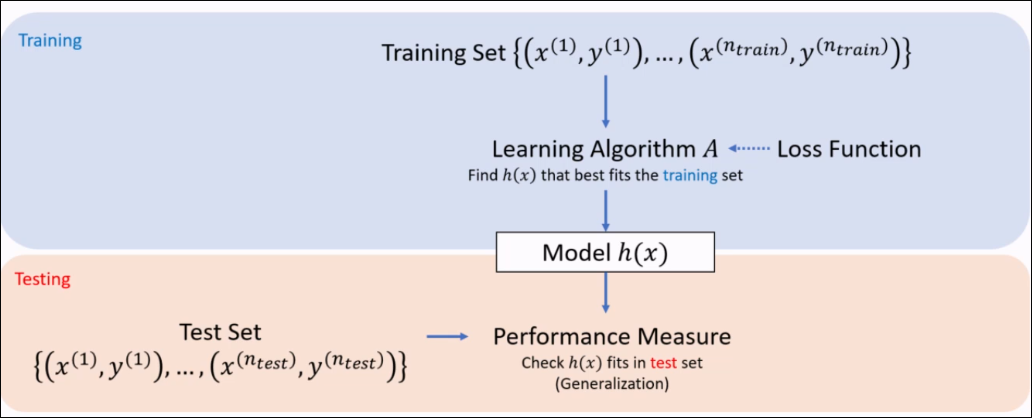
After training, we usually test on an unseen test set. This is used to evaluate the model using various measures. This measures the generalization of the model.
Tasks in Supervised Learning
Classification
- Objective: predict a discrete label - cat or dog?
- Output is a categorical value
- Cancer prediction, Spam detection
Regression
- Objective: predict a continuous numerical value based on input features.
- The output variable is a real number
Data formulation
A dataset is represented as:
is the input vector of features of the data point. - In general,
can be a multi-dimensional array of features
- In general,
is the label for the data point. - Regression:
for regression - Classification:
for classification with classes.
- Regression:
Dataset
Model
Refers to a function that maps from input to outputs:
Performance Measure & Loss
Performance Measure & loss functions take in a dataset
- Performance measure: is a metric that evaluates how well the model performs on a task. Used in evaluation/testing.
- Loss function: Quantifies the difference between the model's predictions and the true outputs. It's used by the model the guide learning to reach the optimal outcome.
Regression
Mean squared error (MSE)
Mean squared error (MSE)
Classification
Accuracy
Confusion Matrix
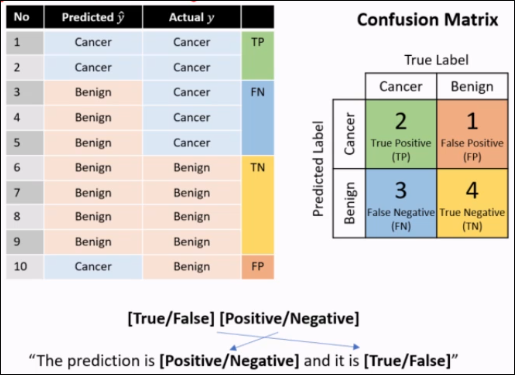
Measure TPR, TNR, FPR, FNR, etc.
Learning Algorihtms
A learning algorithm A takes in a training set
Decision Tree
A decision tree is a model that outputs a categorical decision or prediction. A decision is reached by sequentially checking the attribute value at each node, starting from the root until a leaf is reached.
There generally exists multiple distinct DTs that are all consistent with the training data.
We prefer COMPACT decision trees, are they're less likely to be consistent with training solely due to chance
Entropy
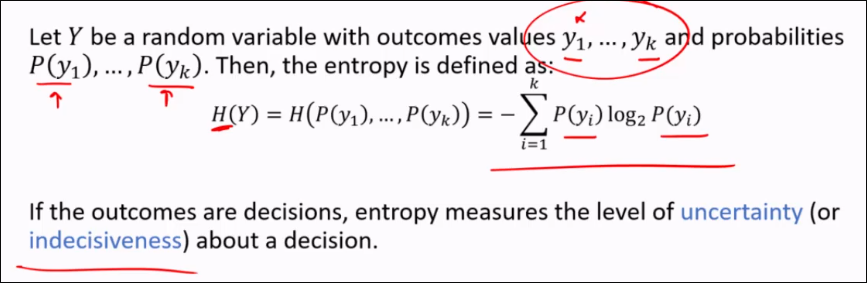
Entropy quantifies the uncertainty or randomness of a random variable.
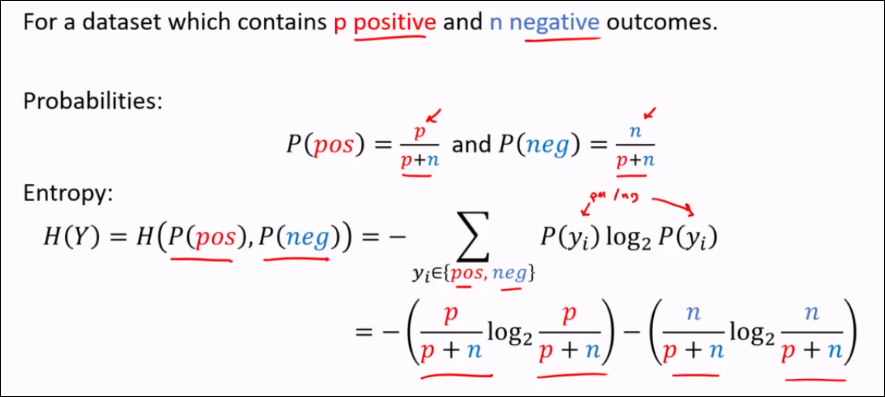
In binary outcomes, entropy is:
Specific Conditional Entropy
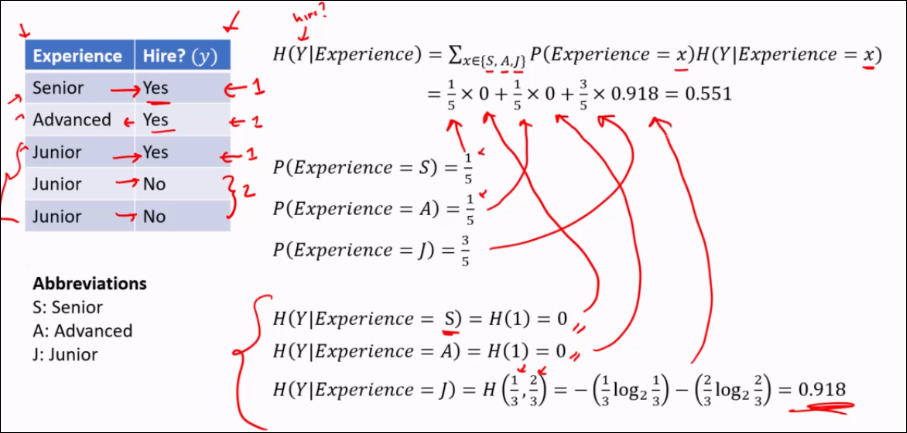
Specific conditional entropy H(Y|X=x) is the entropy of a random variable Y conditioned on the discrete random variable X.
Simply fix the DRV, then calculate entropy as before.
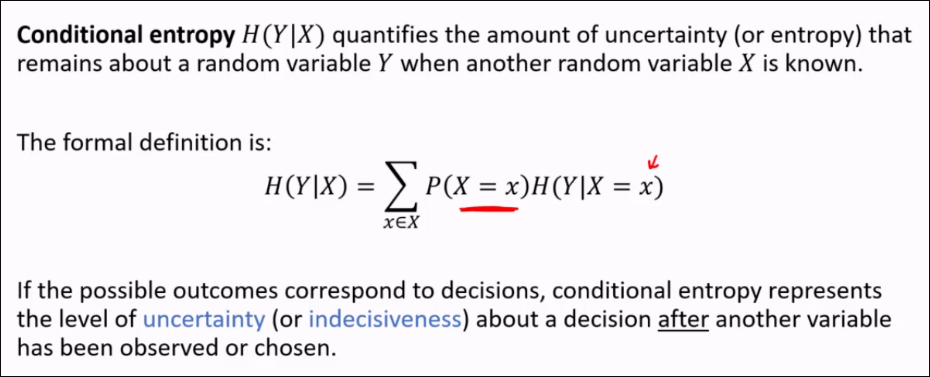
Conditional Entropy
It is simply the Expected Value - multiply the probability of a feature with the specific conditional entropy for each category x in X.
Information Gain
Information gain is a measure of the reduction in uncertainty about a particular decision after knowing the value of a specific variable.
Decision Tree Learning
Top-down, greedy, recursive algorithm.
- Top-down: Build the decision tree from the root.
- Greedy: At each step, choose the locally optimal attribute to split, such as based on immediate information gain, without considering future splits.
- Recursive: For each value of a chosen attribute, use DTL again on corresponding subset of data.
Stopping Criteria:
- No more data or attributes
- All data predicts the same class
DTL - Functions
choose_attribute(attributes, rows)- Accepts a set of attributes (columns) in the data, and the rows containing the data points.
- Computes gain of each attribute
- Returns the attribute that has highest information gain
majority_decision(rows)- Accepts the table rows containing the data points.
- Returns the most common decision in the data points.
DTL - Base Case
- No data available -> return default
- Same classification for all rows -> return that classification
- attributes is empty -> Take majority decision
def DTL(rows, attributes, default):
  if rows is empty; return default
  if rows have the same classification:
    return classification
  if attributes is empty:
    return majority_decision(rows)

  best_attribute = choose_attribute(attributes, rows)
  tree = a new decision tree with root best_attribute
  for value of best_attribute:
    subrows = {rows with best_attribute = value}
    subtree = DTL(
              subrows,
              attributes - best_attribute,
              majority_decision(rows)
            )
    add subtree as a branch to tree with label value
  return tree
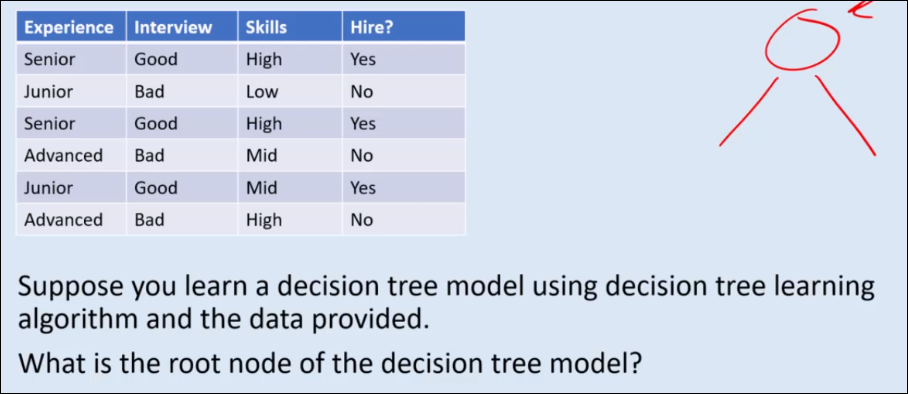
Question:
What is the root node of the DT model based on this data?
DT analysis
Theorem (Representational completeness of Decision Tree)
For any finite set of consistent examples with categorical features and a finite set of label classes, there exists a decision tree that is consistent with the examples.
But this is problematic. The DT then is prone to noise or outliers in excessively complex DTs - overfitting.
DT pruning
Pruning refers to the process of removing parts of the tree. The goal is to produce a simpler, more robust tree that generalizes better.
Common pruning methods:
- Max depth: limits the maximum depth of the DT.
- Min-sample leaves: Set a minimum threshold for the number of samples required to be in each leaf node.